Spotlight on: WSME Enablers
Women own approximately one-third of formal SMEs globally and an even greater share of informal and semi-formal businesses, accounting for over 50% of micro and small enterprises in Sub-Saharan Africa. Yet they remain significantly underserved by the financial sector, reflecting challenges on both the supply and demand sides.
On the supply side, banks, microfinance providers and fintechs face cost-to-serve and capability challenges, including limited capacity to assess lending based on business cash flow rather than collateral, which women often lack. Persistent perceptions that women are riskier borrowers, despite evidence of stronger repayment rates across loan categories, further constrain lending. High returns on government bonds also discourage lending to businesses.
On the demand side, women entrepreneurs are often reluctant to borrow from formal sources, leaving their businesses underleveraged and limiting growth. Mindful of their household responsibilities and financial risks, they also tend to request smaller loans than their male counterparts.
Alliance members are working to change this—combining access to finance with education, networks, information and recognition to help women-owned businesses thrive.
This month’s Ask the Expert session highlighted how five Alliance members—ProCredit North Macedonia, The City Bank Bangladesh, LXME India, Ecobank Togo and FCMB Nigeria—are using non-financial services to support women entrepreneurs and help turn savings into investments.
Our latest member performance data also shows progress: women now represent 27% of SME customers, with average loan sizes reaching 88% of men’s. Yet significant regional disparities remain, and we need more financial services providers to take this on.
This week, we launched our new Gender Inclusive SME Banking Toolkit training, welcoming 187 participants from 53 countries, many from Alliance members.
Over four weeks, participants will strengthen their ability to segment their women business owners, understand their needs and operating environment more deeply, assess their organization’s capacity to finance them and refine their strategies and business case for serving WSMEs. We wish all our participants the best of luck.
Earlier this month, we had the pleasure of supporting the Women Entrepreneurs Finance Initiative (We-Fi) team in organizing the 3rd edition of the Global WE Finance Code Forum, which took place in Paris on October 1 and 2, bringing together a community of champions from 33+ countries already implementing the WE Finance Code. With an ambition to scale to an additional 60 countries in the next two years, the WE Finance Code is truly becoming a global movement, and we are proud to be part of it.
Special thanks to leaders from Banco BHD, National Bank of Egypt, Tyme Group, and The City Bank, who were the first to take part in our Executive Spotlight Series, sharing why investing in the Female Economy is a strategic priority. And thank you to the leaders who have signed up for future editions.
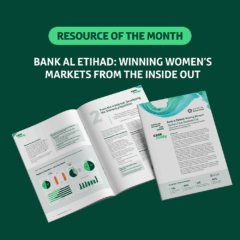
Our resource of the month is a Case Study on Bank al Etihad and how it became the bank of choice for women in Jordan from the inside out.
We are delighted to announce that the Alliance, together with PwC, has been selected by the European Investment Bank to deliver the EU Gender Finance Lab. This initiative will help EU banks better serve women entrepreneurs through technical assistance, training and knowledge services, complemented by a €500 million concessional finance facility.
This achievement reflects the strength of our network and the commitment of our members to advancing women’s financial inclusion.
Thank you to our members and strategic partners for continuing to turn ambition into action.
In community,